Wolves Relisted on Technicality
The gray wolf is once again listed as endangered in Michigan. The USFWS did not gather public comment before the delisting in May 2009. They are beginning the delisting process again, and anticipate opening public comment in winter or spring 2010. The frequent changes in status are confusing, and we are hopeful that a final, carefully considered decision, based on the best available science, will be made in the near future. In a period of just 20 years, the number of wolves in Michigan has increased from one pair to nearly 580 wolves. For the past 12 years, the wolf population has increased every year. They are approaching three times the minimum population that biologists consider to be viable in this state. This has been a conservation success that should make the people of Michigan proud.
Is Removing Protection Good for Conservation?
With success in conservation comes change. State and federal endangered species laws were written to protect species that are in danger of going extinct in the foreseeable future. Wolves clearly do not meet this definition; managing wolves as though they are endangered and about to go extinct causes conflict. Different management tools are necessary for abundant species, compared to endangered species. Ultimately and over the long term, wolf conservation will require that managers use a variety of tools to manage problem wolves. If delisting is good for wolves, it is also good for other species. Keeping abundant species listed diverts precious tax dollars from truly endangered species to abundant species. The conservation of all endangered species demands that we celebrate success and remove endangered species protections from species like wolves that no longer need those protections. We hope that the US Fish and Wildlife Service will move quickly and deliberately to delist wolves in the near future, while following carefully the administrative rules and laws regarding federal actions. For more information on how Michigan manages wolves, see Michigan Wolf Management Plan (2008).
click here
Life History
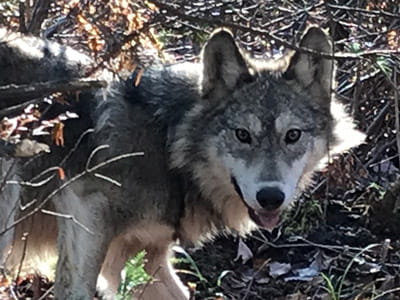
Gray wolves (a.k.a. timber wolves and eastern timber wolves) are the largest member of the Canid family (wild dogs), which also includes coyotes, and red and gray foxes. The sub-species found in Michigan is Canis lupus lycaon. As adults, gray wolves average 30 inches in height at the shoulder and 65 pounds. Their feet are generally 3 1/2 inches wide and 4 1/2 inches long, and provide an easy way of differentiating wolves from coyotes, whose feet are only 1 1/2 inches wide and 2 1/2 inches long.
In Michigan wolves eat deer, beaver, snowshoe hare, rodents and other small mammals, and may also eat woodchuck, muskrat, coyote, raccoon, insects, nuts, berries and grasses. They are the only Canid species in Michigan that hunts in a social unit (the pack). While wolves can go for a week without eating, when they do eat, their meal may include 20 pounds of meat at a time.
Although wolves do not need "wilderness" (i.e. non-managed, roadless areas), they do need large areas of contiguous forest in which to range. They also need stable populations of their preferred prey. Wolf habitat is enhanced by timber cutting, wildlife habitat management and other practices that create more diverse and productive forests. Generally, a pack of gray wolves will roam an area of at least 100 square miles.
Wolves have a very strict dominance/sub-ordinate social structure that is constantly being maintained and reinforced. A typical pack consists of one alpha male, one alpha female, the young of the year, and a few others that may or may not be related to the alpha pair. New packs are often formed by lone wolves who have broken from a pack, but have been able to find a mate and new territory in which to hunt. In Michigan, the average pack size is expected to be around six members, but may be as small as two members. Pack size is dependent on the amount of prey available.
Breeding (between the alpha male and female only) generally occurs in February, with six to ten (average seven) pups born in April in a den prepared by the alpha female. While the pups are still nursing, the alpha female remains with them and is fed by the rest of the pack. After the pups are weaned, the alpha female will again join the pack in hunting and all members of the pack aid in providing the pups with nourishment through regurgitation of meat. When the pups are old enough, they are moved out of the den and often to a nursery area, called a "rendezvous site", where they remain while the adult members of the pack go out to hunt. This area is often located in rank vegetation near water, such as a beaver flooding that has since become a wild grass meadow. Although they are still tended by the adults, who bring them meat, this is where the young learn hunting skills by practicing with shrews, mice and other small animals.
Communication occurs between wolves in many ways, such as scent marking, but howling may be the most fascinating. Wolves are believed to howl in order to reconvene the family, announce a kill and for the simple joy of communication.
Michigan History
Wolves were once present in all 83 counties in the state of Michigan. Persecution and active predator control programs throughout the 20th century virtually eliminated the gray wolf from Michigan: by 1840, they could no longer be found in the southern portion of the Lower Peninsula; by around 1910 they had completely disappeared from the Lower Peninsula; and by 1960, when the state-paid bounty on wolves was repealed, they had nearly vanished from the Upper Peninsula. The last known pups born, before the 1990s resurgence of wolves in the state, were produced in what is now the Pictured Rocks National Lakeshore in 1954-56.
The species remained unprotected in Michigan until it was given full legal protection in 1965. The federal government listed the gray wolf as endangered under the Endangered Species Act (ESA) in 1973.
An attempt to translocate four animals from Minnesota to northern Marquette County in 1974 failed. All four animals were killed within several months.
Through the 1980s the only verified sightings of wolves, other than on Isle Royale, were of individual animals, but in 1989, the tracks of two wolves traveling together were verified. In the spring of 1991, this pair produced pups, the first to be documented on the mainland of Michigan in 35 years. By this time, the majority of Michigan residents were ready for the gray wolf to return to their state. Survey results indicated that 64 percent of Upper Peninsula respondents and 57 percent of Lower Peninsula respondents supported wolf recovery.
The current Michigan population is believed to be descendants of animals that immigrated to the Upper Peninsula from populations in Wisconsin, Minnesota or Ontario.
The current Michigan population is believed to be descendants of lone animals that immigrated to the Upper Peninsula from populations in Wisconsin, Minnesota or Ontario.
The comeback of the gray wolf in Michigan is a remarkable wildlife success story. Estimated at 20 animals in 1992, Michigan's gray wolf population has grown to at least 520 animals in 2008, and the 2008-2009 winter count is expected to be even higher. While state and federal endangered species laws have helped make this comeback a reality, the most important factor has been the willingness of Michigan's citizens to accept the gray wolf as part of our natural heritage. This continued public support for wolf recovery is critical as our wolf population continues to grow.
The state of Michigan has made a commitment to the ongoing protection and management of its wolves. An annual "Michigan Wolf Awareness Week" for the month of October was initiated in 1992. In July of 1992, DNR Director Roland Harmes appointed a 10-member Michigan Gray Wolf Recovery Team, which he charged with the task of developing a wolf recovery plan for Michigan. The "Michigan Gray Wolf Recovery and Management Plan" was completed and signed by the Director on December 15, 1997.
Michigan Gray Wolf Population, 1989-2004
Click on image for larger version
Gray Wolf Recovery
Not so long ago, Michigan did not have a sustainable wolf population. Years of predator control and bounties had all but eliminated wolves from Michigan. In 1973, it was estimated that no more than 6 animals lived in Michigan's Upper Peninsula. These individuals were maintained by immigration of wolves from Ontario and Minnesota, where their populations were more stable.
Federal delisting criteria (developed in 1992) include a combined MI/WI population of 100 wolves for 5 consecutive years. The combined population has exceeded 100 wolves every year since 1994 and currently includes more than 1,000 wolves. The Michigan Wolf Recovery and Management Plan (1997) defined a viable population as 200 animals for 5 consecutive years. We have exceeded 200 animals for 10 years. Because recovery goals have been met, the DNR and US Fish and Wildlife Service have begun steps to remove this species from state and federal endangered species lists.
Recovery from endangered status is not the end of the story for wolves, but only a new beginning for management. The recently completed Michigan Wolf Management Plan (link) (2008) outlines future directions for management, and a wolf management advisory group will be established to discuss wolf management and conservation in Michigan.
Non-DNR Links
International Wolf Center
> "Was that a wolf?"
> "Living with Wolves: Tips for avoiding conflicts"
Canis lupus
(University of Michigan, Museum of Zoology)
Gray Wolves in the Western Great Lakes(U.S. Fish & Wildlife Service)
Wolves in the Upper Great Lakes(Northern Michigan University, Seaborg Center)
Wildlife Species: Canis lupus
(USFS Fire Effects Information System)
Gray Wolf(The Wild Ones)
Wolf(Canadian Wildlife Service)
Timber Wolf(Wisconsin Dept. of Natural Resources)
Gray Wolf(National Wildlife Federation)